
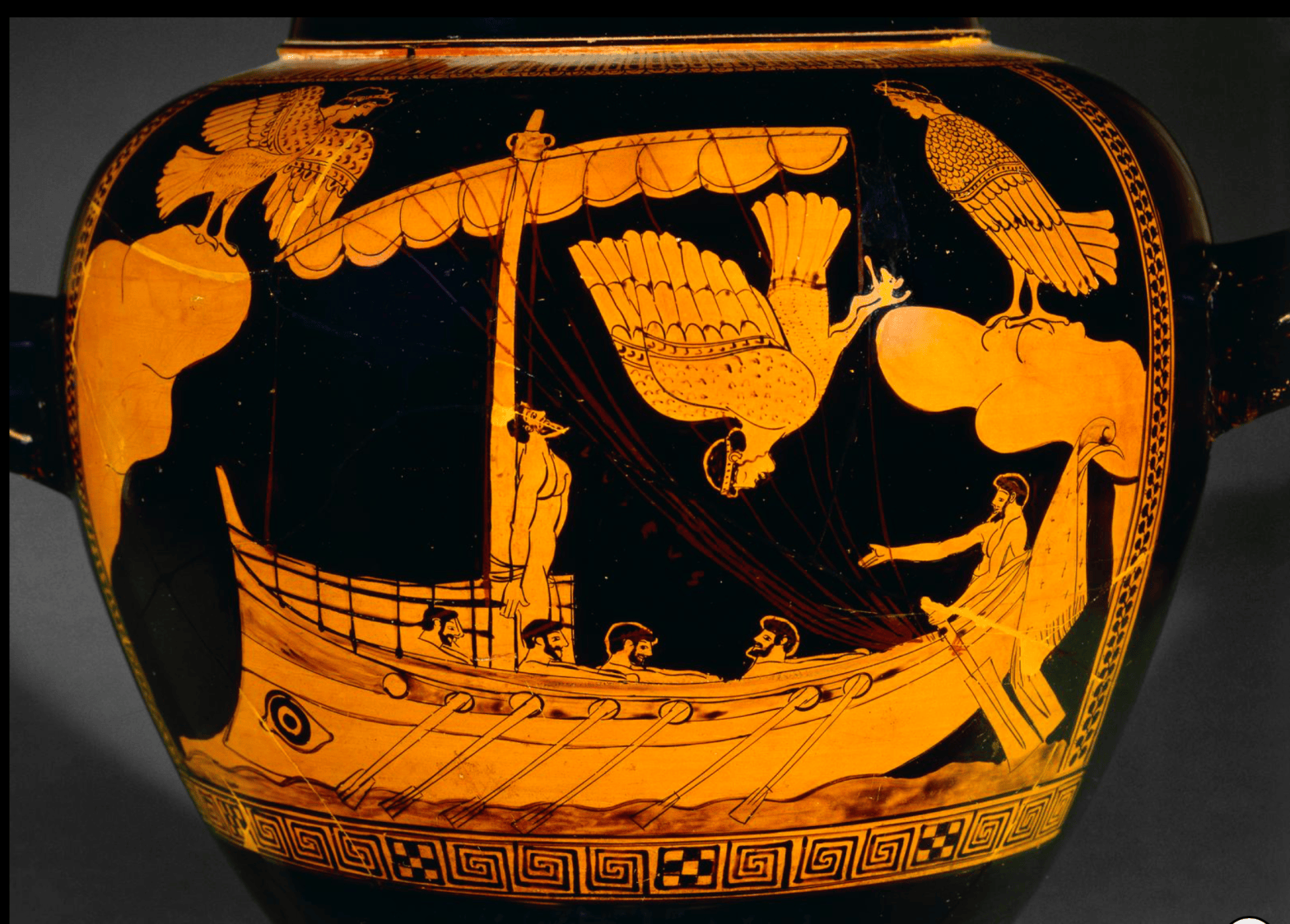
I find it wildly entertaining (double meaning intended) that the latest cinema blockbuster is The Odyssey starring Matt Damon, Anne Hathaway, Tom Holland, and other Hollywood staples. The movie is a fairly accurate retelling of Homer’s epic poem written around 800 BC, considered the first work of Western literature. Some of my entertainment has come learning that there are educated people out there who didn’t know it was based on a “book.” People who had never heard of the Trojan War, or even much of the Greek mythology these tales centered around. The best moment though was seeing a former high student of mine from 20 years ago post that he was re-reading the epic in anticipation of seeing the movie. I jokingly inquired whether I had missed his class in teaching it, or if he just hadn’t read it. I received a quote about “rosy-fingered dawn” in reply while he went on to share that in high school he thought the story was decent, but the wordiness too much. Now as a grown adult he’s eating up the tale and maybe a little thankful for the seed planted when he was a tenth grader.
So really, why The Odyssey now in theaters, but also why did I teach it year after year to ninth or tenth graders who truth be told might have only been minimally interested in such an old piece of literature? I had a father ask me one year why my syllabus included that and other works of antiquity such as Medea and Antigone. I briefly explained that it was the first work of Western literature and that much of what came to follow stemmed from it; how could I not start there? He was unconvinced. I’ll admit that I did have one ambitious year wherein I also had The Iliad and The Aeneid on my summer into first semester curriculum. Let’s just say I learned that may have been a bit much for high school, but I did keep The Odyssey for 15 years, supplementing with abridged versions of the other epics as needed to set the stage and discuss impact.
At its core The Odyssey is of course a tale of trials and journeying, subjects common to man throughout time and all over the world. More importantly, it is considered the first work of Western literature. Countless stories find their origins in the framework established by Homer. In his work, The Hero with a Thousand Faces, Joseph Campbell outlines the concept of the monomyth, or hero’s journey. According to Campbell, a protagonist with heroic traits moves through three main stages: departure, initiation, and return; several sub-stages are defined as well. The Odyssey, being possibly the first major work to show a hero journeying through the monomyth, then sets the stage for many more works to come, right up through present day. film maker George Lucas references Campbell’s work as influential in his crafting the journey of Luke Skywalker in the original Star Wars trilogy. An argument could also be made for Han Solo and/or Princess Leia completing their own monomythic story arcs. Books, films, and television series such as Harry Potter, Lord of the Rings, Pirates of the Caribbean, LOST, and others follow this same pattern with their protagonists and sometimes supporting characters.
Given the prevalence of this framework, it should be no surprise that we are now coming full circle and re-creating Homer’s original epic for the cinematic audience. It’s not only a storyline we find familiar, even if some did not know its origin, and it’s in familiarity we find comfort. Albeit Christopher Nolan puts his own spin in places by choosing which scenes to include and which to leave out, as well as presenting Odysseus in a way viewers sympathize with despite his many missteps. Homer highlights his pride and the downfalls of his seeking for comfort. Readers of the original work may have to struggle more with cheering on a “hero” who isn’t quite as virtuous as we may like. But either way, we can appreciate his humanity and find common ground knowing the best choice isn’t always the easy one and sacrifices must often be made for a greater good. I’d probably more accurately describe him as morally ambiguous, another character trope we’ve seen for ages.
While it’s hot, watch the movie. Read the poem (in prose if it’s more palatable). Consider looking at Campbell’s work as well, even if a summary and descriptions of the steps of the monomyth. Look for similar journeys in other works you read or watch. And ask yourself, “If a story still has relevance 1800 years after it was first written, what about that story resonates and is applicable to my life today?” You may even discover more ancient works with truths for today.
 Girl with Dog