Why WWII?

In my last post I wrote about the significance of Homer’s Odyssey and why it was making a comeback in a huge way through Hollywood film making. For close to the last decade another subject from history has also had me questioning significance: World War II historical fiction.

Several years ago the monthly bookclub I attend was reading a novel titled Sarah’s Key. While it’s been a long time since that read, I do recall it being centered around a mystery from WWII. I won’t plot spoil what I do remember, but suffice to say it was set in France and dealt with the hiding of Jewish people during the war. While it was incredibly frustrating and deeply saddening to read what was based on true life events, this book led us down a path that still continues today: reading works based in this time period. What keeps us reading and why are books with this theming still written and published in 2026?

I believe to a degree everyone has a sense that history tends to repeat itself and many horrors of the past should be learned from and never see the light of day again. So many lessons could be learned just from the experience of the Holocaust. I don’t presume to have adequate words to discuss how terrible a stain on humanity this period of history is, but many authors have attempted to shed light on these atrocities. I did have the opportunity two years ago to visit the Dachau concentration camp. Seeing the physical remains put into perspective the words I had read both in fiction and in historical sources. It is a real place, as are a startlingly high number of other camps across Europe, even if they are not still standing. The first building we went into contained a large map of these camps and I was surprised at how little we really have heard about their magnitude and existence. One topic that was reiterated over our time in Germany, from Munich to Berlin, was how much the German people have owned their role as a country and as individuals. They teach and show openly in their cities what happened with the desire to not ever be culpable in such horrors again. There is a lesson we can learn from that.

Much of the historical fiction being written strives to cover as much true material as possible. There are biases, of course, but enough novels and settings are covered that a fuller picture is there if one takes the time to read for it. As someone of strong German descent I have struggled at times with my heritage, but through reading I have also seen that a country’s entire identity cannot be boiled down to one or more groups or individuals. I first read, then taught, The Book Thief to my tenth graders for a few years. Here amidst the events of Kristallnacht, book burning, Hitler Youth, a march to Dachau, and others, we find families trying to resist and help their fellow neighbors and colleagues who are Jewish. This theme is evident in many of the works I’ve read since.

In preparation for a recent trip to Florence, Italy, I picked up a book based on the work of the Monuments Men (and women) who were tasked with protecting and recovering art during and after the war. This led me down a rabbit hole of reading several works on the subject and they repeatedly raised the question of whether this protection was worth human lives. The resounding answer was yes. Art, and architecture, are just as much a vital part of history as humanity. Much of art is evidence of the best of humanity, of our desire for beauty and also our capacity to create. At the risk of sounding trite, a picture is often worth a thousand words, as are sculptures and buildings. The great works that have stood the test of time give us hope for what lasts beyond our limited life spans. In the words of J.R.R. Tolkien, through the voice of Samwise Gamgee, “There is some good in the world. And it’s worth fighting for.”

In America we have to go back many generations to find a war fought on our home soil, against a foreign enemy. Yes, the attacks of 9/11 struck at home, and certainly I don’t mean to lessen that terrible act of terrorism, but these were very limited in scope to wars lasting years and years. We haven’t felt the strains of occupation by a foreign power: watching friends, family, and neighbors losing their jobs, homes, and lives in large numbers. We haven’t had to live on rations, lining up in hopes of getting a small portion of what our weekly grocery trip used to provide. We haven’t had to hunker down in cellars while air raid sirens blare praying that when we later emerged our homes would still be standing and our loved ones wouldn’t be buried under rubble. Hopefully reading these works gives us perspective and remind us to appreciate all that we have, and recognize that there are parts of the world today struggling still with war and the horrors it entails.

Recommended Reads:

The Nightingale – Kristin Hannah

All the Light We Cannot See – Anthony Doerr

Beneath a Scarlet Sky – Mark Sullivan

The Book Thief – Markus Zusak

Code Name Hélène – Ariel Lawson

The Last Masterpiece – Laura Morelli

The Alice Network – Kate Quinn (or really anything by Kate Quinn)

Sarah’s Key – Tatiana de Rosnay
Why the Odyssey?

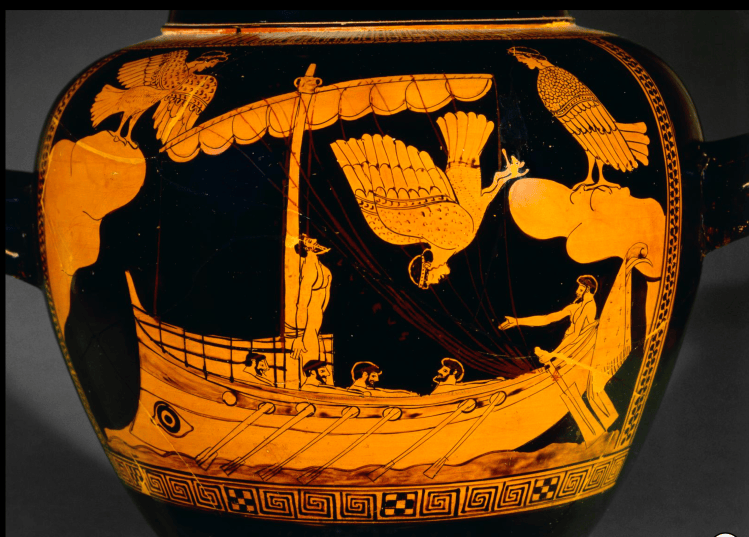
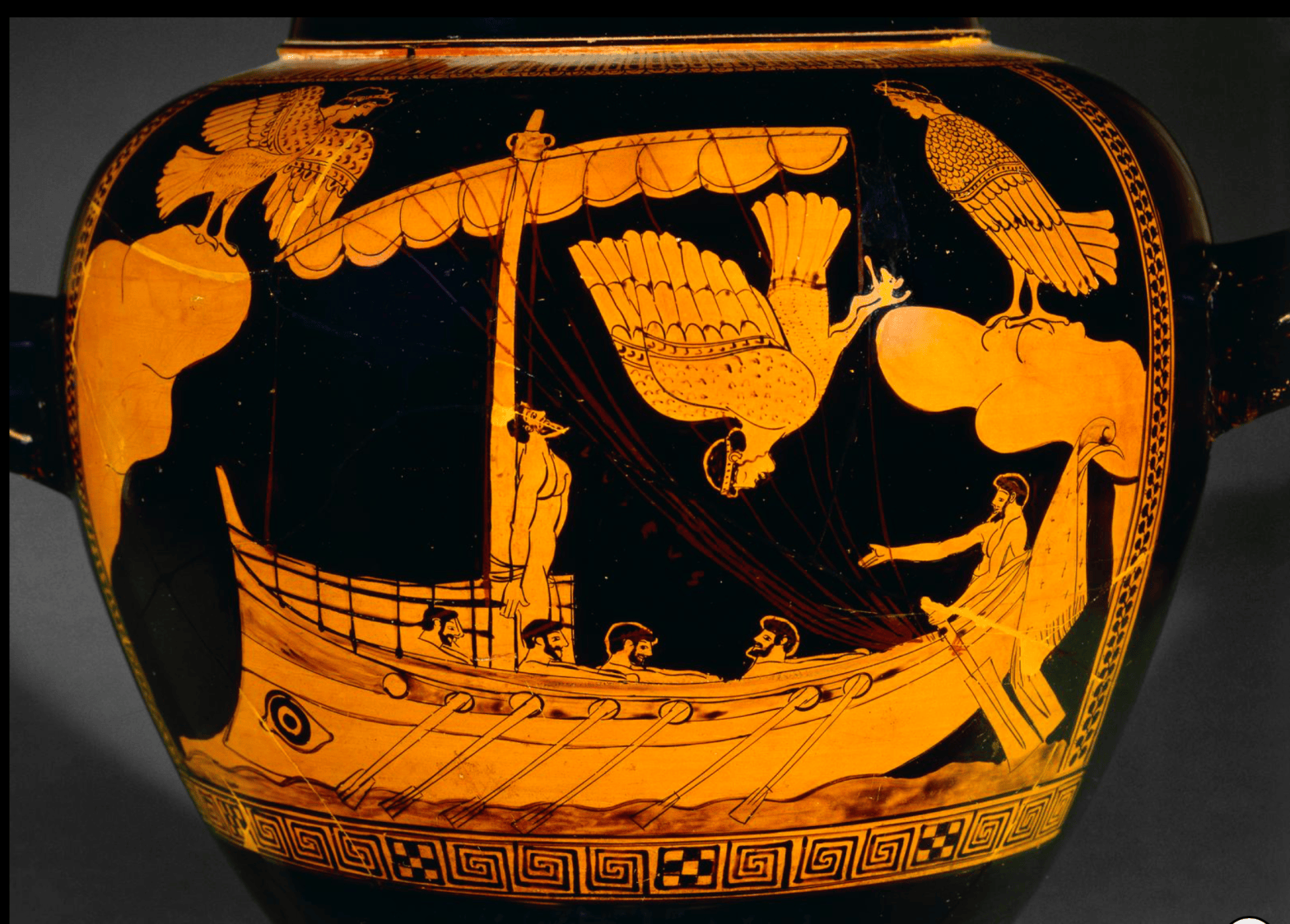
I find it wildly entertaining (double meaning intended) that the latest cinema blockbuster is The Odyssey starring Matt Damon, Anne Hathaway, Tom Holland, and other Hollywood staples. The movie is a fairly accurate retelling of Homer’s epic poem written around 800 BC, considered the first work of Western literature. Some of my entertainment has come learning that there are educated people out there who didn’t know it was based on a “book.” People who had never heard of the Trojan War, or even much of the Greek mythology these tales centered around. The best moment though was seeing a former high student of mine from 20 years ago post that he was re-reading the epic in anticipation of seeing the movie. I jokingly inquired whether I had missed his class in teaching it, or if he just hadn’t read it. I received a quote about “rosy-fingered dawn” in reply while he went on to share that in high school he thought the story was decent, but the wordiness too much. Now as a grown adult he’s eating up the tale and maybe a little thankful for the seed planted when he was a tenth grader.

So really, why The Odyssey now in theaters, but also why did I teach it year after year to ninth or tenth graders who truth be told might have only been minimally interested in such an old piece of literature? I had a father ask me one year why my syllabus included that and other works of antiquity such as Medea and Antigone. I briefly explained that it was the first work of Western literature and that much of what came to follow stemmed from it; how could I not start there? He was unconvinced. I’ll admit that I did have one ambitious year wherein I also had The Iliad and The Aeneid on my summer into first semester curriculum. Let’s just say I learned that may have been a bit much for high school, but I did keep The Odyssey for 15 years, supplementing with abridged versions of the other epics as needed to set the stage and discuss impact.

At its core The Odyssey is of course a tale of trials and journeying, subjects common to man throughout time and all over the world. More importantly, it is considered the first work of Western literature. Countless stories find their origins in the framework established by Homer. In his work, The Hero with a Thousand Faces, Joseph Campbell outlines the concept of the monomyth, or hero’s journey. According to Campbell, a protagonist with heroic traits moves through three main stages: departure, initiation, and return; several sub-stages are defined as well. The Odyssey, being possibly the first major work to show a hero journeying through the monomyth, then sets the stage for many more works to come, right up through present day. film maker George Lucas references Campbell’s work as influential in his crafting the journey of Luke Skywalker in the original Star Wars trilogy. An argument could also be made for Han Solo and/or Princess Leia completing their own monomythic story arcs. Books, films, and television series such as Harry Potter, Lord of the Rings, Pirates of the Caribbean, LOST, and others follow this same pattern with their protagonists and sometimes supporting characters.

Given the prevalence of this framework, it should be no surprise that we are now coming full circle and re-creating Homer’s original epic for the cinematic audience. It’s not only a storyline we find familiar, even if some did not know its origin, and it’s in familiarity we find comfort. Albeit Christopher Nolan puts his own spin in places by choosing which scenes to include and which to leave out, as well as presenting Odysseus in a way viewers sympathize with despite his many missteps. Homer highlights his pride and the downfalls of his seeking for comfort. Readers of the original work may have to struggle more with cheering on a “hero” who isn’t quite as virtuous as we may like. But either way, we can appreciate his humanity and find common ground knowing the best choice isn’t always the easy one and sacrifices must often be made for a greater good. I’d probably more accurately describe him as morally ambiguous, another character trope we’ve seen for ages.

While it’s hot, watch the movie. Read the poem (in prose if it’s more palatable). Consider looking at Campbell’s work as well, even if a summary and descriptions of the steps of the monomyth. Look for similar journeys in other works you read or watch. And ask yourself, “If a story still has relevance 1800 years after it was first written, what about that story resonates and is applicable to my life today?” You may even discover more ancient works with truths for today.

Digging too Deep

Recently I was listening to a podcast and heard the statement, “Grief is just love with no place to go.” Man that resonated with me. Looking it up after I got home I found the full quote, “It’s all the love you want to give, but cannot. All that unspent love gathers up in the corners of your eyes, the lump in your throat, and in that hollow part of your chest.Grief is just love with no place to go.It’s attributed to Jamie Anderson, a writer of Doctor Who novels; of course a show that deals with deep grief in many of its story arcs would be related to the concept here.

“Grief is just love with no place to go”

Jamie adnerson

Nature abhors a vacuum so it makes sense that when we lose someone or something we love, we search for a place to give that love, or we search for someone or something to fill the empty space left by no longer having that loved one in our lives. 

After I lost my mom four years ago I think I began to fill the lost space with digging deeper into coaching and mentoring. At the time I thought I was just keeping busy, maybe avoiding the grief a bit, but finding focus so that I could move forward. There were days when I was tempted to not get out of bed, but I had girls relying on me to show up for them. My love had a place to go. I coached practices and races and did Bible studies and was invited to birthday celebrations and planned or hosted team bonding events. I dove deep. 

The time and energy was reaping some benefits in that the team was getting better too. The concerted effort to give feedback both in person and via text, and to encourage an environment that was fun and supportive began to lead to successes like having our first girl qualify for state. 

A year and half into this process I lost my dad as well. His death was less expected and more sudden and now I had more love without a place, and a deeper hole to fill. Add to that COVID hitting shortly after, and having the team now making a push for state as a group, and I dove deeper. Couldn’t practice as a group during a pandemic lockdown? No problem, I drove around town meeting smaller groups. We rode bikes, and ran, and checked in with each other. I cared and I thought they too needed a focus beyond what the world was currently throwing at them. They needed me, they needed each other, right?

We all ended up pushing hard and achieving some lofty goals that season, but not without some cost. In the end we were a little worn out. I was a lot worn out. I had dug so deep that the hole was starting to fall in a bit. The answer? To change coaching environments entirely. Maybe the love that was caving in needed a new place to go.

The problem with that approach is that leaving, moving, often leads to its own grieving process. We mourn the what was while we are still figuring out the what is. The love doesn’t always carry forward the way we think it will. We try to dig a new well to drown it in, but we hit harder soil, or maybe a few rocks, or maybe our shovel has gotten dull from digging too hard previously. Maybe the shovel just breaks.

Possibly we have to just carry the love, and the grief a bit longer before we find its place. It’s a process with no quick or easy answers. I’m sure where it will take me, but in the interim I’m digging more carefully.

Finding Place

So far June has been a weird month. This morning I’m thinking it all has to do with finding “place.” The 2nd would’ve/should’ve/could’ve been my mom’s 70th birthday. Four plus years after her death I still have some conflicting feelings about how she passed and the years leading up to it. I’m not sure I’ll ever truly have those resolved. What I do know is that with her and my dad both gone and no siblings, I feel displaced, untethered, orphaned. My in-laws have also been visiting the last few days and we celebrated my mother-in-law’s 75th birthday. I don’t begrudge the celebration or my husband having his family, but it does highlight my lack. 

June has also brought the start of a new coaching position for me. On paper I have a new place: new school, new team, new opportunities. Exciting stuff, right? When I agreed to move forward my husband’s rule was “No tears.” I’ve already broken that. Finding my exact place is proving a bigger challenge than I thought. Though I am still working with my coaching partner of the last several years, someone who has also been a good personal friend, our dynamic isn’t the same. We’ve gone from both being head coaches (he boys, me girls) working in tandem with each other, to being head coach and assistant. There’s an awkwardness of not knowing what my voice is, or my exact role. I excelled at relationship building and developing the team culture for my girls in the past. I grew to be an adept running coach as well and expanded my knowledge base gaining confidence along the way. Now I show up and have limited responsibility, and uncertainty in what I’m supposed to be doing. The kids and the parents that I’ve met so far have made me feel welcome, but I feel like I’m stumbling along not sure what my actual interactions should be. While I understand the practicality of my head coach saying going into this that we would have to figure it out as we go, I didn’t anticipate it feeling so damn uncomfortable. 

We’re taught sometimes that it’s a good thing to leave our comfort zones, that true growth happens when we muddle through discomfort. But then how do we know when something is the right fit? How much time do we allow to pass in the uncomfortableness before we decide it just isn’t working or what we want? How do we deal with the ick of feeling like we don’t belong…at least not yet?

A couple weeks probably isn’t enough time to make a determination. In my coaching past I’ve asked girls to dig deep into foreign territory stretching themselves both physically and mentally. I’ve asked them to believe big things and to commit to working hard to achieve big goals. At the heart of my coaching was always the push though to find place, to build an environment where they each had a role to play and a family to surround them. Right now I’m the foreigner entering the new territory trying to establish my place. The discomfort is real, but maybe necessary? Only time will tell.

To be continued…

Letting Nature Take Its Course

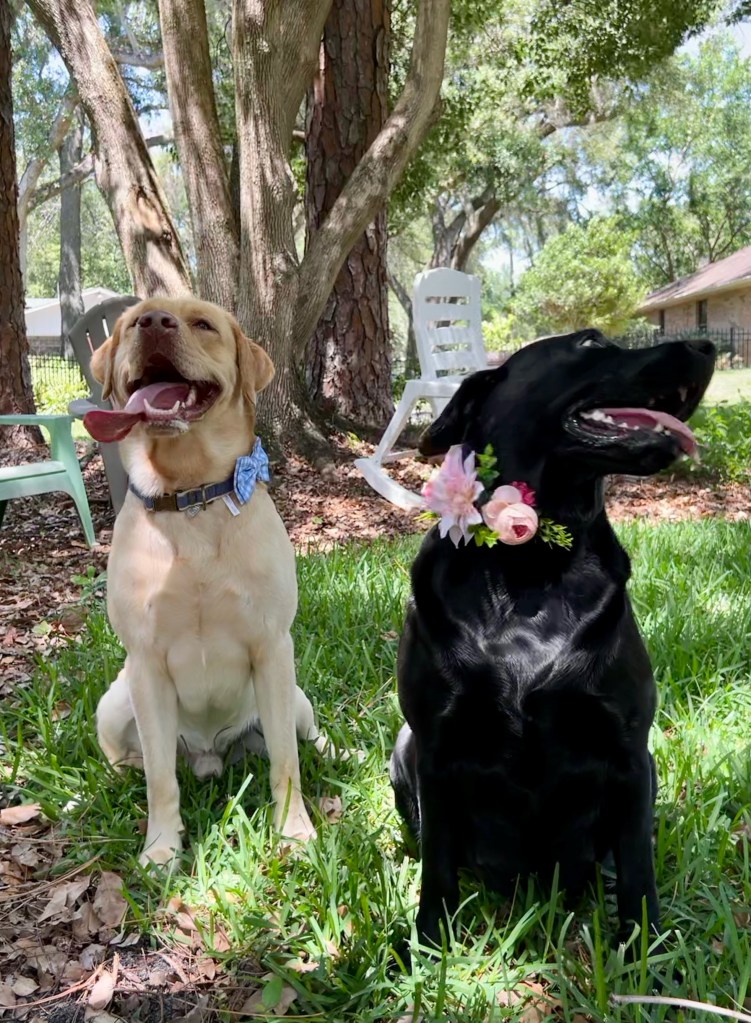
Dad: Barley & Mom: Piper

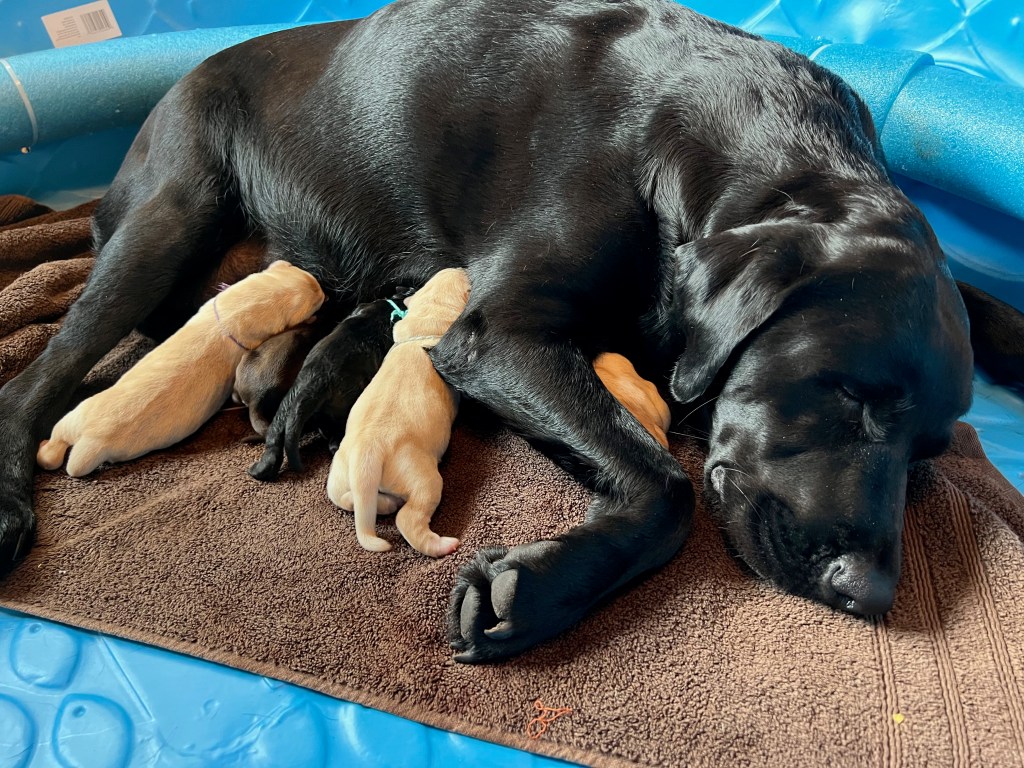
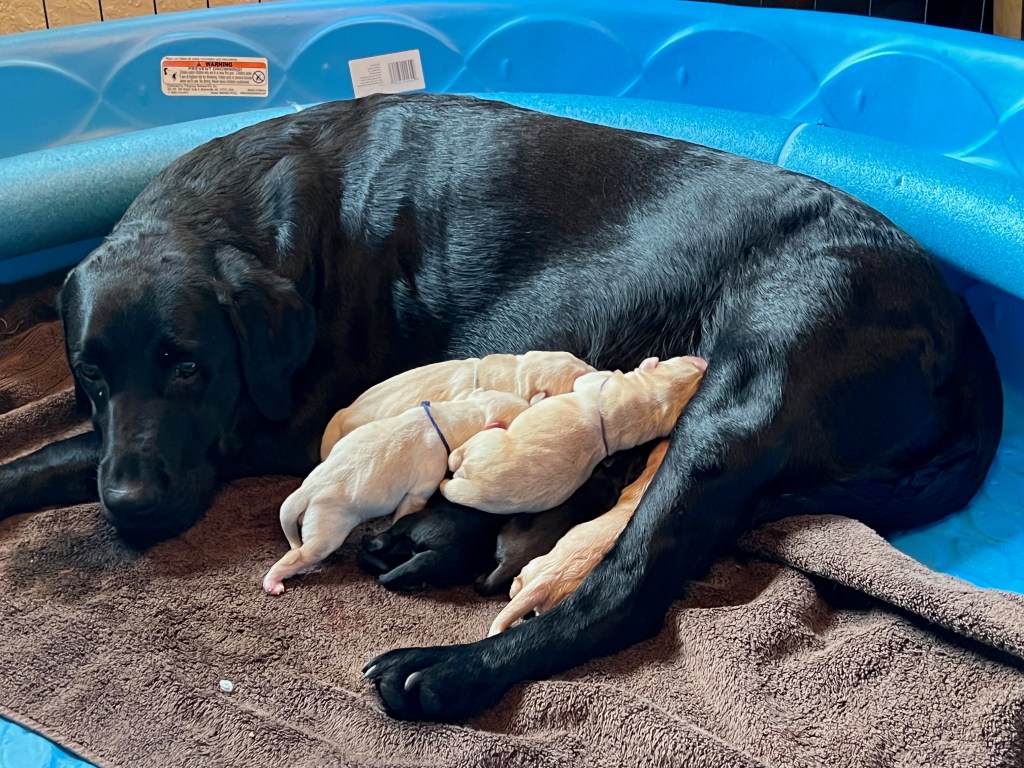
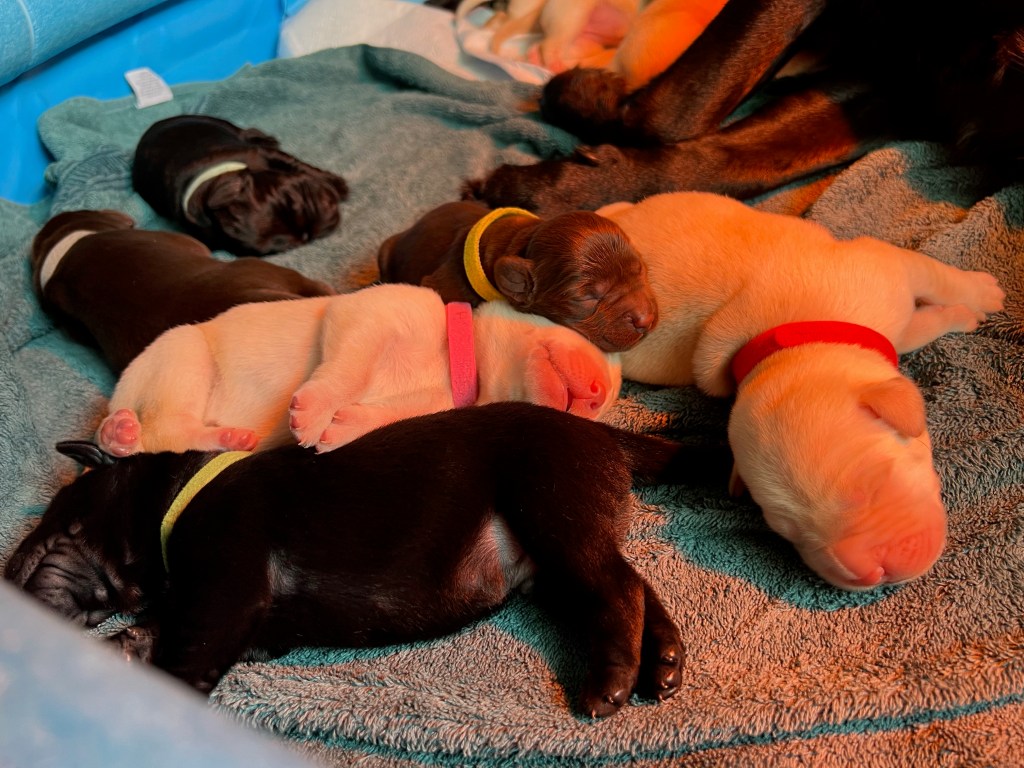
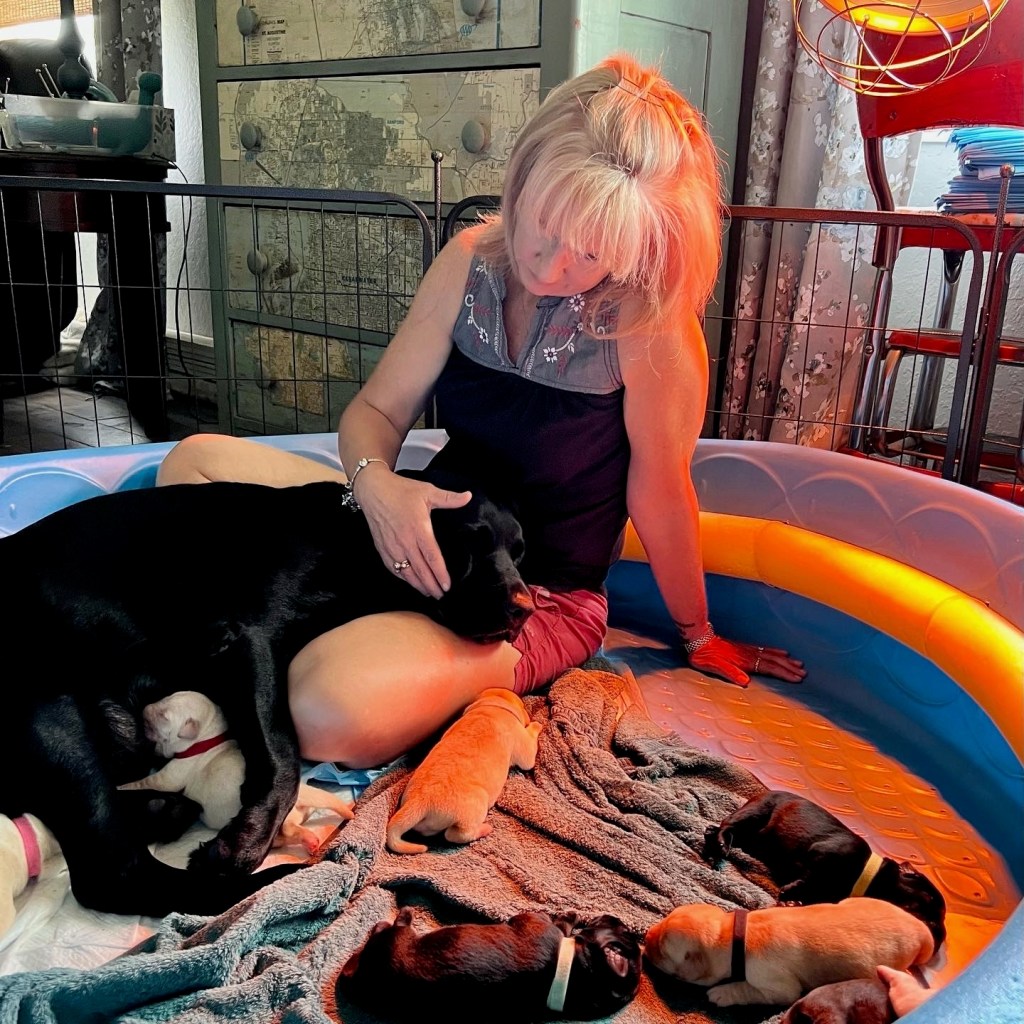
Last week I had the new experience of watching a dog give birth to ELEVEN puppies. We had somewhat inadvertently bred our male yellow lab with our best friends’ female black lab. When we got the parents as puppies the long range plan had been to mate them after they were two years old. While they technically are now two years old, in an ideal world we were waiting for one more heat cycle, but nature, or instinct, had other plans. We didn’t realize Piper was in full blown heat when we got all our dogs together for a normal playdate back in March. I turned my back on them for a couple of minutes, and well, was a little mortified to discover them in action. What, though, were the chances it was going to take on the first encounter, brief as it was since I insisted on breaking up the arrangement? A little over a month later and Piper was showing definite signs of pregnancy, with only about three and a half weeks to go. Not only were they not entirely planned for, the puppies would be due the day before our friends’ daughter graduated from high school. 

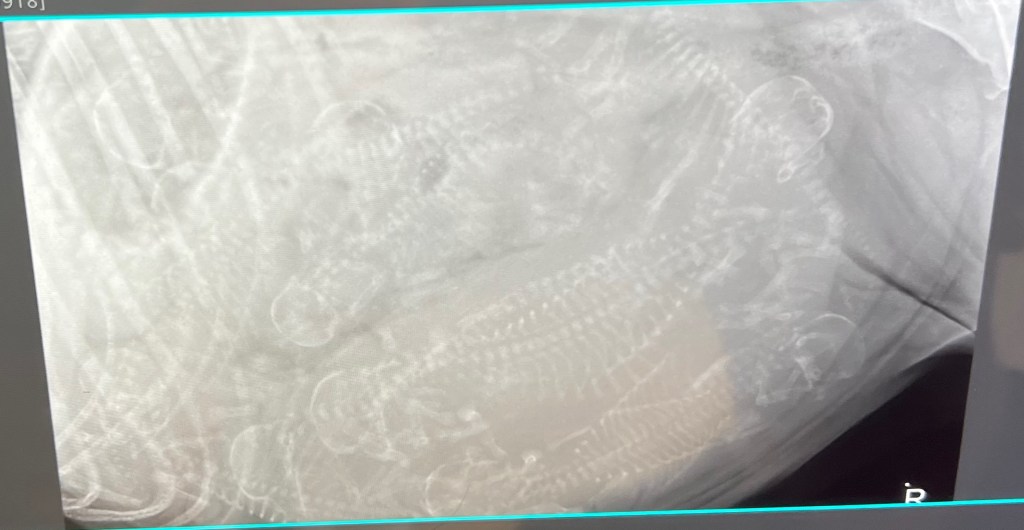
There was an element of denial, but what we thought was hopefully enough preparation. On Tuesday we took Piper for an x-ray to see how many puppies to expect. We placed our bets, mostly going conservative as it was such a brief mating and her first litter. The most common guess amongst all the family members was 7. Seemed reasonable. The vet techs brought in the x-ray and said they counted 10 skulls, but were waiting on confirmation from the doctor. Doc comes in and reiterates the count of 10, but maybe 11. Back at their home my friend and I counted again. Definitely 10 skulls, but what about this “extra” spinal cord that doesn’t appear to be attached to a head, that kind of trails off the x-ray boundary?

X-Ray: 10 heads, 11 spines

Still thinking we have a few days until the delivery, everyone attempts business as usual until Wednesday morning when I get a text that the dogs are acting weird, would I come over and sit with them while friend goes to an appointment, just in case. While I’m getting ready to head over, I get a frantic text saying Piper’s water has broken. So much for plans. I hurried the 3 miles to their house and walked in to my friend completely wigged out because the cat had chosen that exact moment to bring a mouse in and drop it in the whelping box (kiddie pool). Thankfully I’m not super squeamish and the mouse ran under a blanket so I could grab it and throw it outside. Now…how long to wait for the puppies to come?

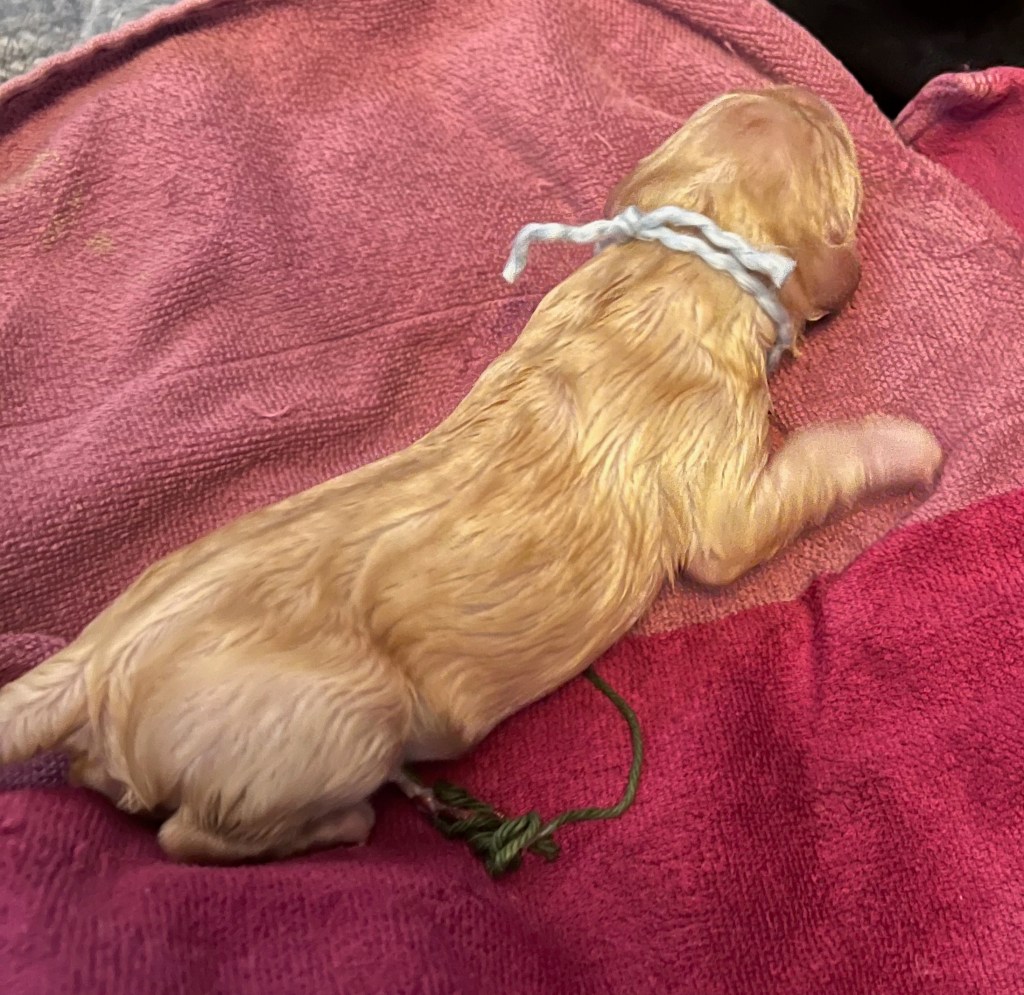
Number 1: “Baby Blue” (a.k.a. Big Blue or Porker)

Online sources led us to believe it could still be hours until the first delivery. Nope, an hour later puppy number one, a healthy, hardy yellow male came out. In our excitement and lingering panic, we probably helped a little too much, but all in all it was a successful delivery and he remains the biggest of the litter. Then we waited. And waited. The vet the day before had said call if more than 30 minutes passed. Everything we read in the book my friend purchased and online said not to worry until 4 hours. At 2 hours, 15 minutes, puppies two and three arrived together, but one was stillborn. We posited that maybe that’s why there was a delay, cleaned up the healthy pup, another yellow but female, and assisted in making sure both puppies were nursing. We intend to let Piper handle that birth more independently, but the stillborn threw us off a bit. Okay, next round would be better. 

My husband came over, brought us some lunch, and decided he wasn’t getting any more work done for the day so stayed to see how the rest of the births would go. Another two hours passed and we decided to sit within eyesight, but try not to stress out mom by hovering. Let nature take its course. Next thing we know my friend’s older son walks by and says “There’s another puppy…no, wait, there are two more puppies.” Crap. Rush over and sure enough, Piper had given birth again, this time to a tiny chocolate female, and another yellow female. Now I was really wondering if the double births were happening when one pup wasn’t strong enough. But small as she was, the little chocolate was feisty and willing to nurse. The remaining six puppies started coming about every 30 minutes or so and were all thankfully healthy and hearty, and mom was getting the hang of cleaning them up herself and nursing in between. Total labor and delivery was about 8 hours. At that point all human family members were home and we decided what we had read about providing a calm, quiet birthing environment was overrated. Our dogs were used to chaos and activity and that probably felt more normal. 

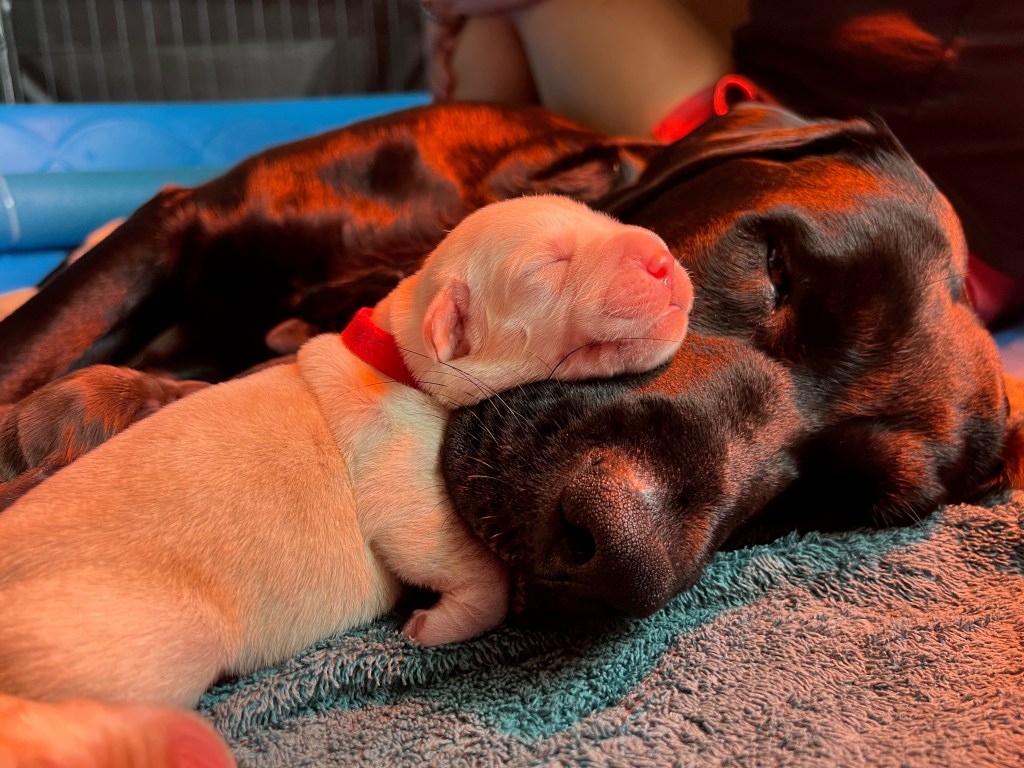
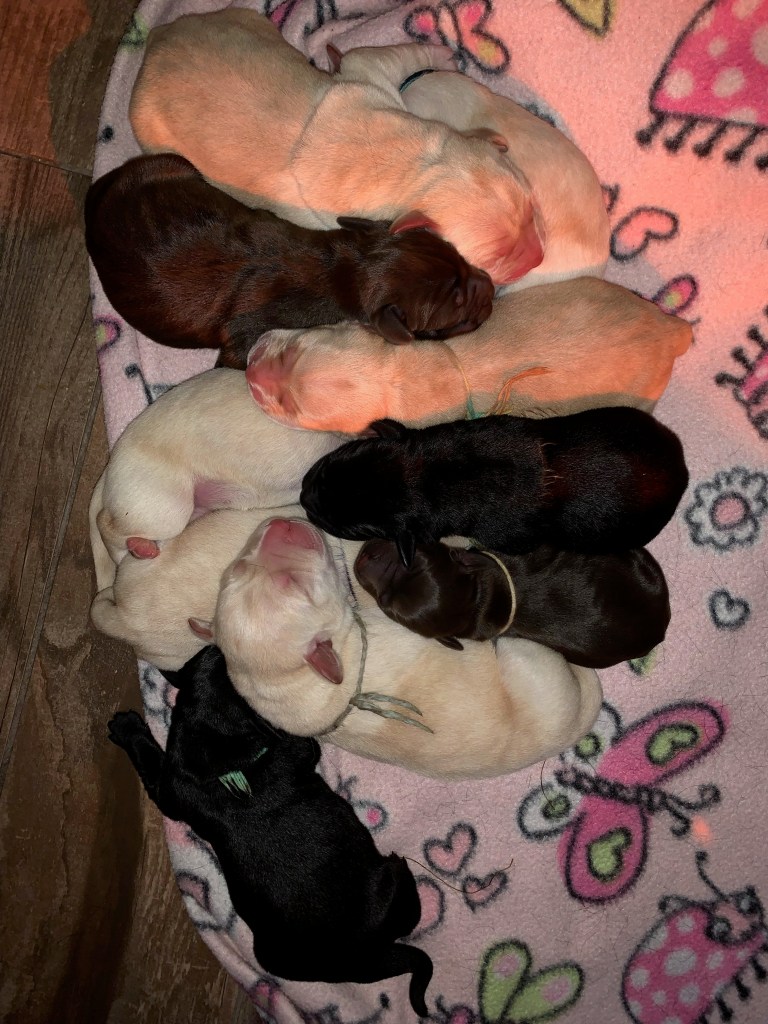
Five days later, the 10 surviving puppies are continuing to grow and gain weight and Piper has been a rockstar getting the hang of motherhood. She knows where all her babies are at any moment and will retrieve one from your human lap if she decides to do so. We’re supposed to be calling them solely by their collar colors and not naming them as they will eventually go to other homes, but we each have our favorites and have nicknamed a couple of them. The first boy is “Baby Blue” but also “Porker” since he continues to be the biggest; “Little Miss” is technically “Yellow” but she’s taken a little extra care so I’ve also named her “Peanut.” In keeping with Peanut, I’m calling the only other chocolate, a bigger male, Charlie Brown. We get pick of the litter and had said ahead of time we’d like a chocolate so I’m not really concerned about naming our potential new family members. 

Our friends may beg to differ as they are bearing the brunt of the care and initial stress of the unplanned adventure, but I think there’s something to be said for letting nature take its course. I’m a planner too, and I generally hate change, but sometimes we get in ruts and we need a little shaking up. Sometimes we need a distraction that forces us not to worry about situations outside of our control. Sometimes we need to see that someone else should be allowed to take the reins of care. Sometimes we need to be reminded of what’s really important…family and being there in the moment, being there for each other, remembering the fun times and ties that got us to this place. And sometimes we really really just need to cuddle a puppy…or 10!

Running the Rabbit Trails

This particular post began as a bunny hop down a few side trails. Here’s to hoping the message still comes through…

I recently finished another personal race season, something I usually do opposite of my cross country coaching season. This allows me to be able to focus on my own training without having to work it in around a busier time of year, and also so I’m free to train with the team when needed. As with my cross country runners, at the end of a race season, I’m supposed to take some down time to recover before going back into base training mode. While one purpose of such a break is physical rest/recovery, just as important is the mental rest. Unfortunately that can be the bigger struggle.

In the last few years, running has become for me a kind of therapy, or means to process through a lot of what life throws at me. I’ve had some fairly aggressive runs the days after each of my parents died. I both went into and bounced back from two surgeries with solid running strategies geared toward keeping me healthy so my body took the trauma better. And often I’m using running as a mental processor, to clear my head, to help runaway thoughts come together more cohesively, to manage the rabbit trails of grief, or loss, or change, or anger, or sadness…you name it. 

What I didn’t time well this season was ending my racing at a time when grief would be a little higher, and I suddenly had no other distractions. April is the month I lost both my mom and my grandma, who was a strong mother figure to me. In the oscillating, ambushing way grief works, it slammed into me a bit as I “relaxed” into my recovery phase. The double whammy is that I’m also in a stage of transition. I’m fully ending my tenure at one school, having stopped teaching there two years ago and now finishing up my coaching role. I’m in process of potentially moving into a new position at another school. At the moment, I don’t feel I truly belong in either place. 

Belonging. Be. Longing. Maybe that’s the root, the base trail, my brain is trying to wrap around as I’ve pounded through the last couple runs that were supposed to be fun and exploratory. Usually I enjoy these micro-sessions of not having set paces, or locations, or goals. I pull up the map and search out places I haven’t run before, places where there might be literal bunny trails (or deer, bear, or boar trails) to deviate onto. Instead I’m pounding out paces I didn’t even hit during race training. I already feel a bit untethered and the thought of going somewhere new is daunting. In the mean time, I don’t know if I’m running through the crazy, or running away, or trying to catch up to what remains ahead, somewhat unclearly in the distance.

What I know is to run. To give myself grace for whatever this current recovery session looks like. I can lace up my shoes, I can attach myself to a dog or two, I can revisit routes that are still familiar but I haven’t done in a while. The explorations will still be there when my mind is done rabbit trailing and my body is ready to have a turn.

Don’t Over-Map It

A tale of two bike rides…

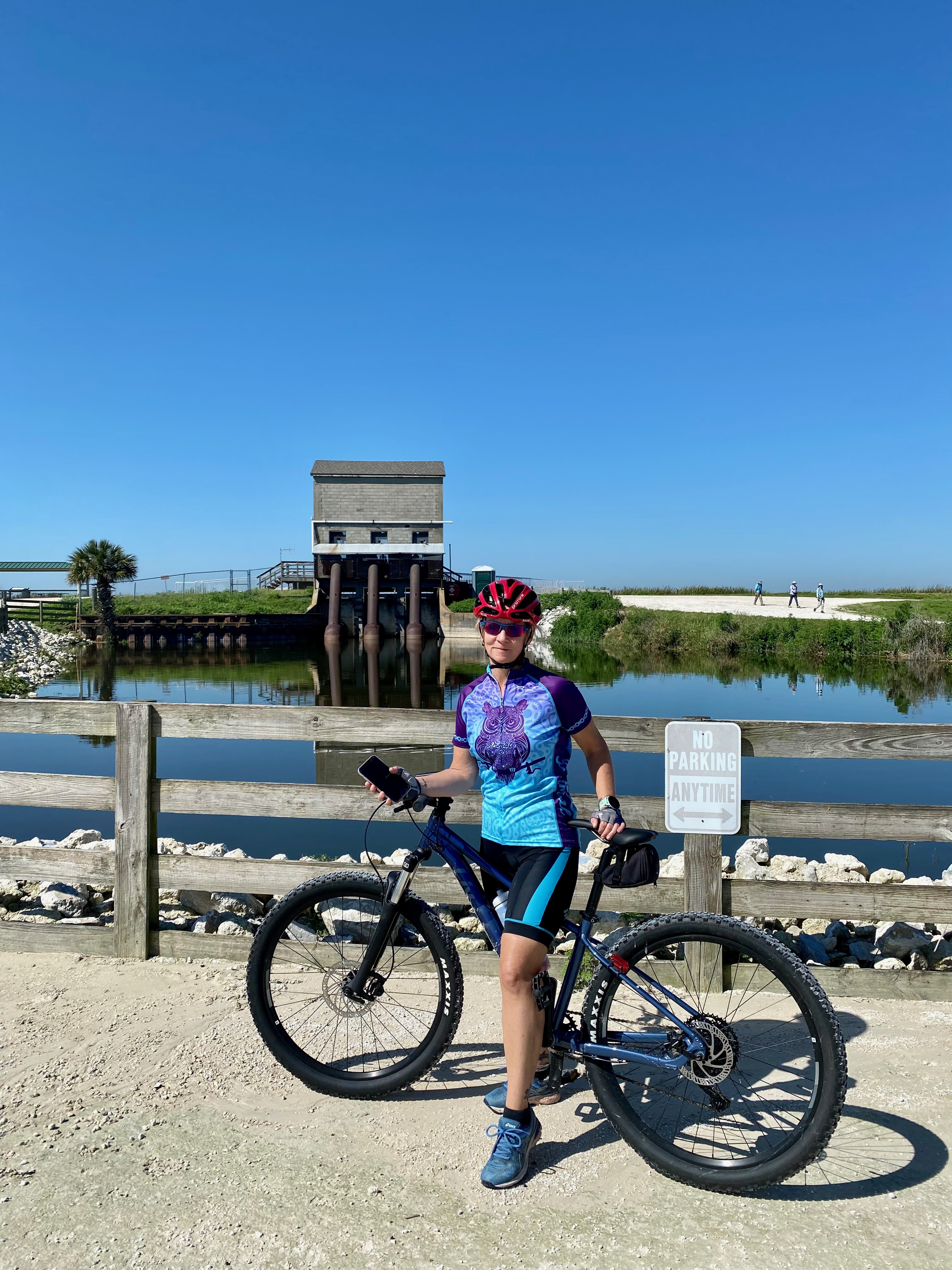
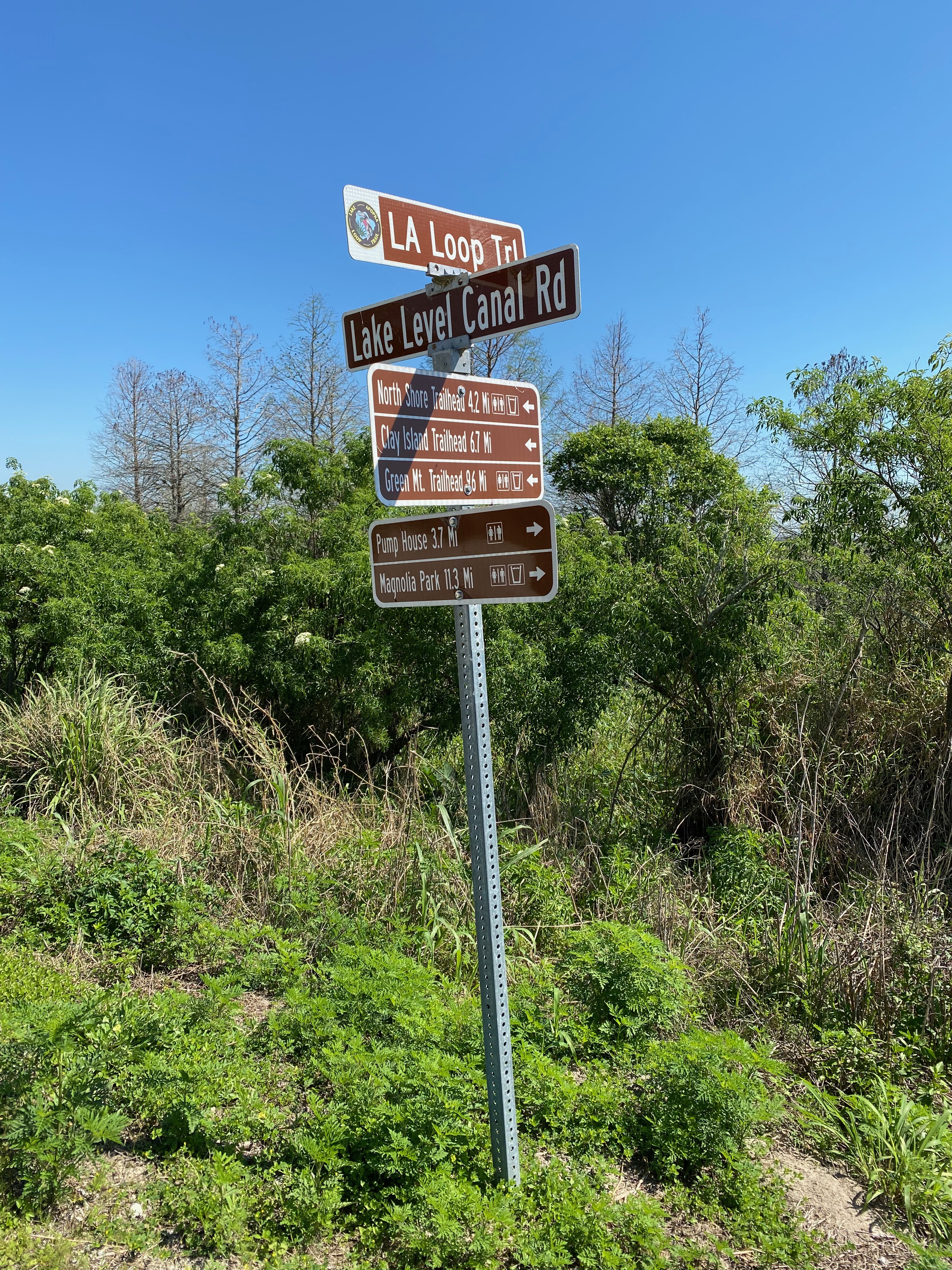
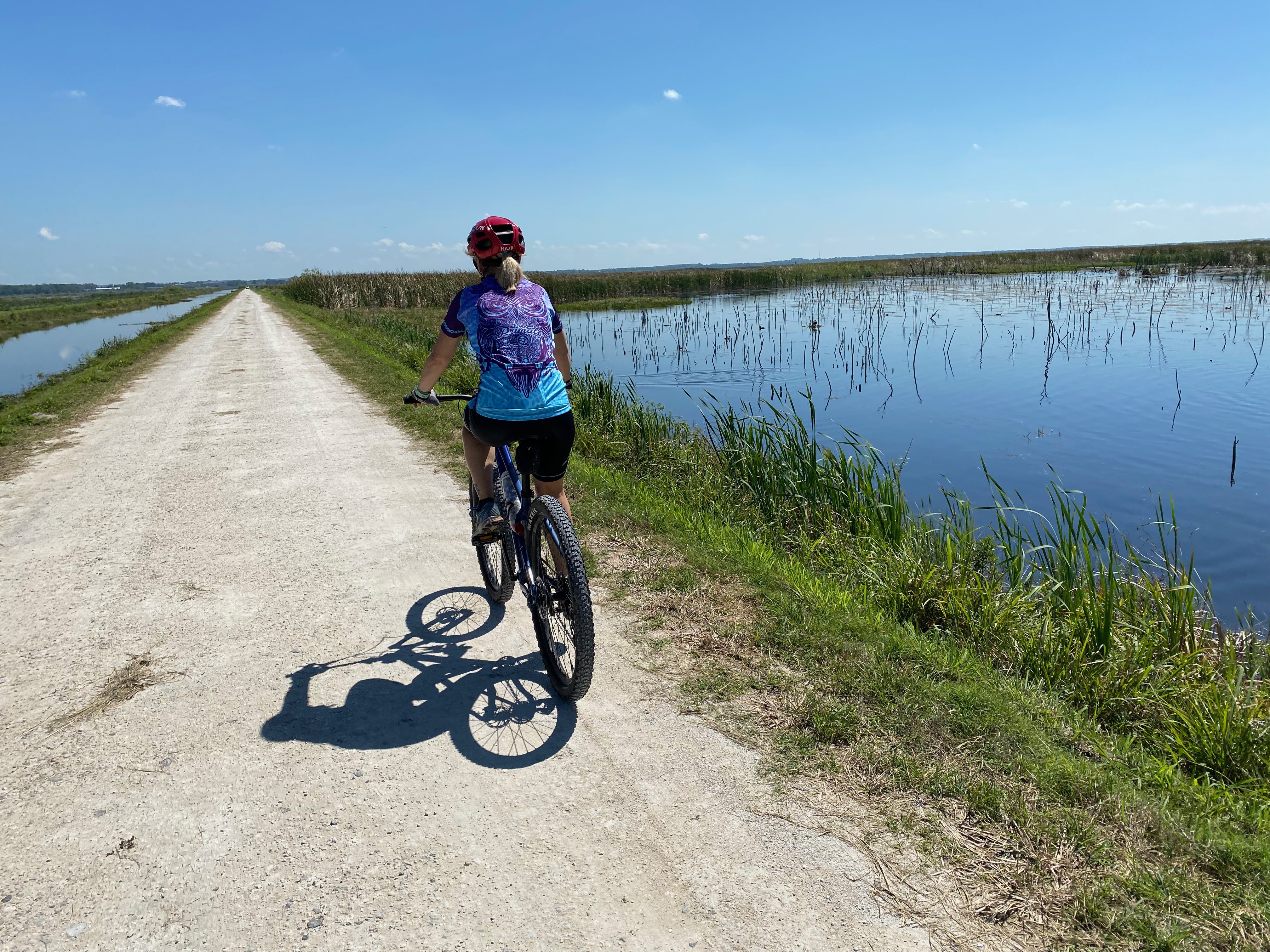
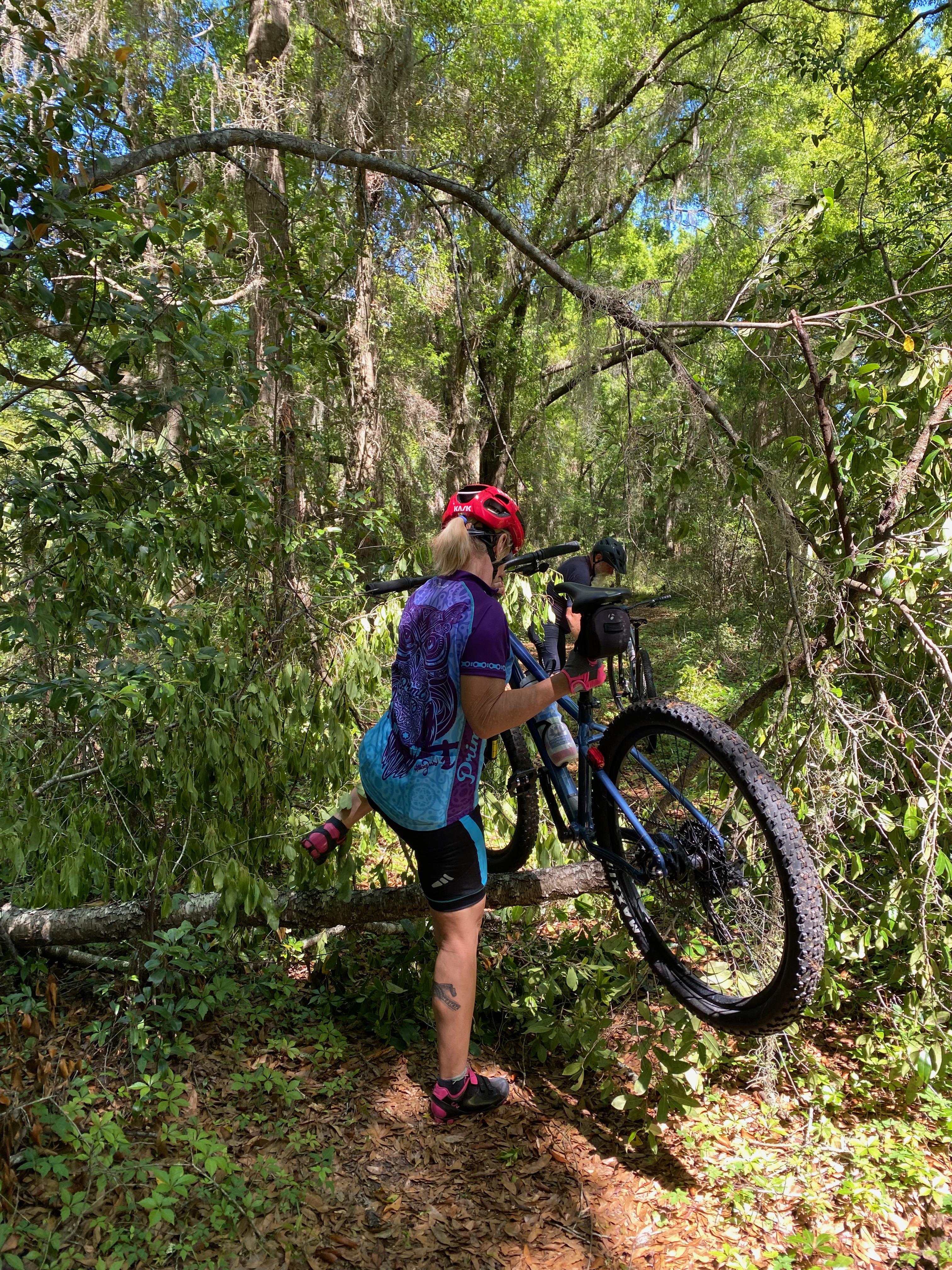
Friday morning my husband was working from home, becoming increasingly frustrated with the database he had to access going down. In the midst of the first lag he texted me a map of a gravel trail around a local large lake. My response: Let’s go! At first he hesitated since he wanted to knock some work out first, but as his frustrations increased he agreed that a break would be good. We loaded up and drove the 40 minutes to a trailhead, which ended up being closed, but we found the next closest entry point and eventually got going. It was a beautiful day, and a very scenic route with plenty of wildlife encounters: mostly gators and a variety of birds. We got a little turned around at one intersection, but pulled out a map of the trail and kind of figured out which way to go. Since we usually enjoy “drawing” interesting maps through our GPS trackers, we opted to try a different way back, against the road traffic. Not quite as scenic as we spent a lot of time dodging cars, but there were plenty of gators starting to sun themselves along the roadway so that kept it interesting, if a little nerve wracking. All in all it was a great morning and we made plans to invite a biking friend of ours along on the next attempt, already plotting how to do the whole trail end to end. 

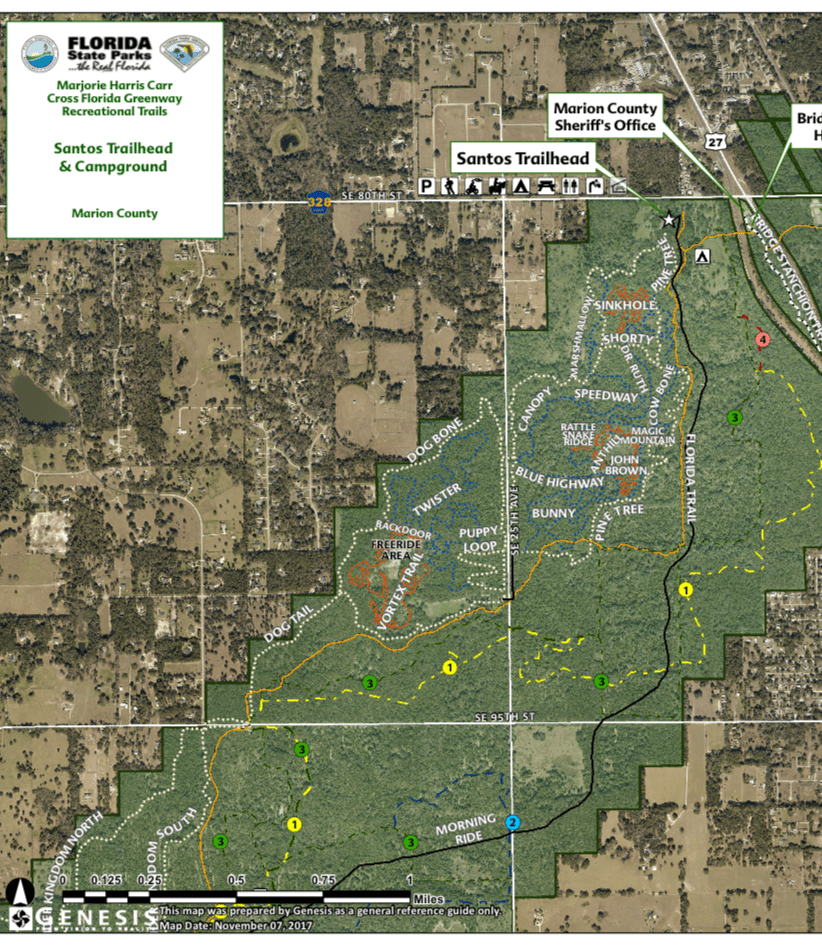
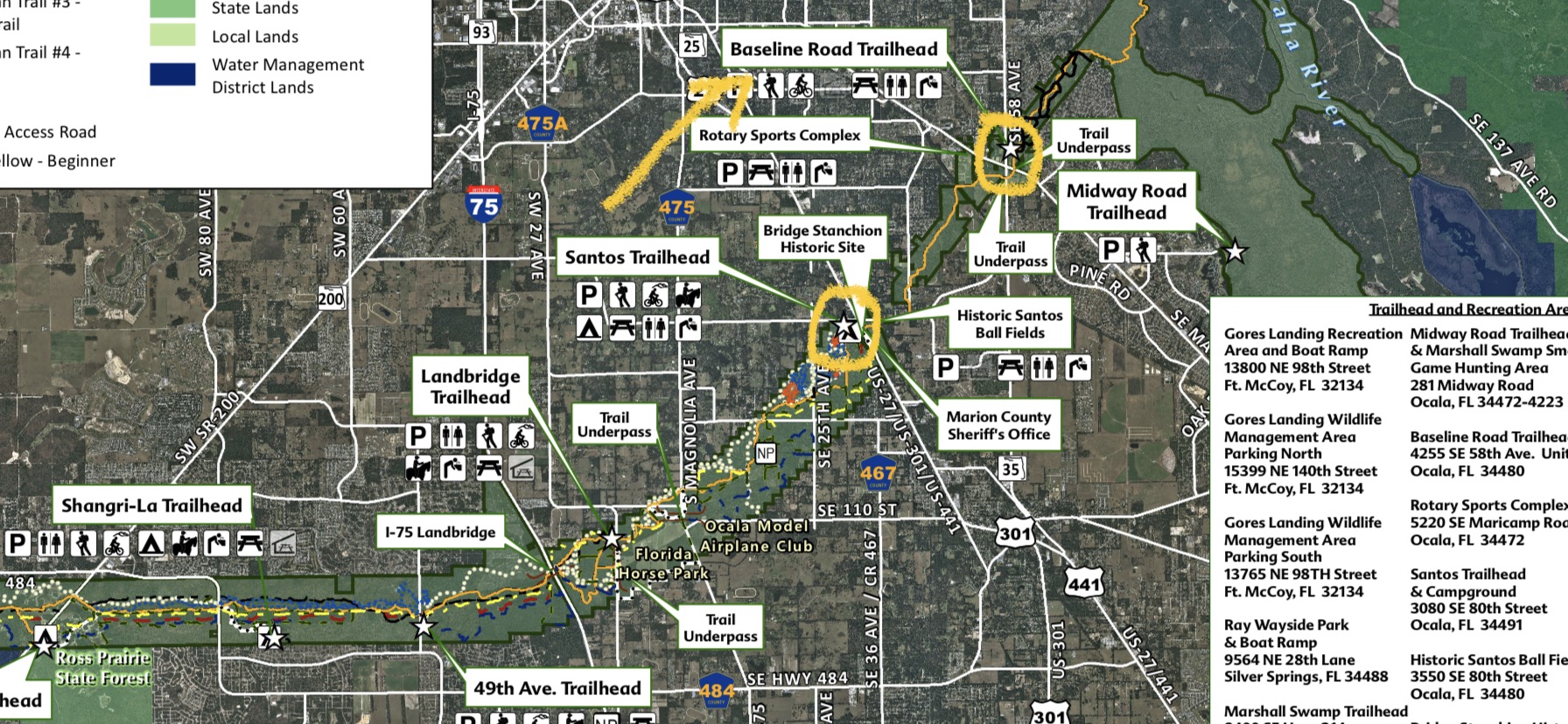
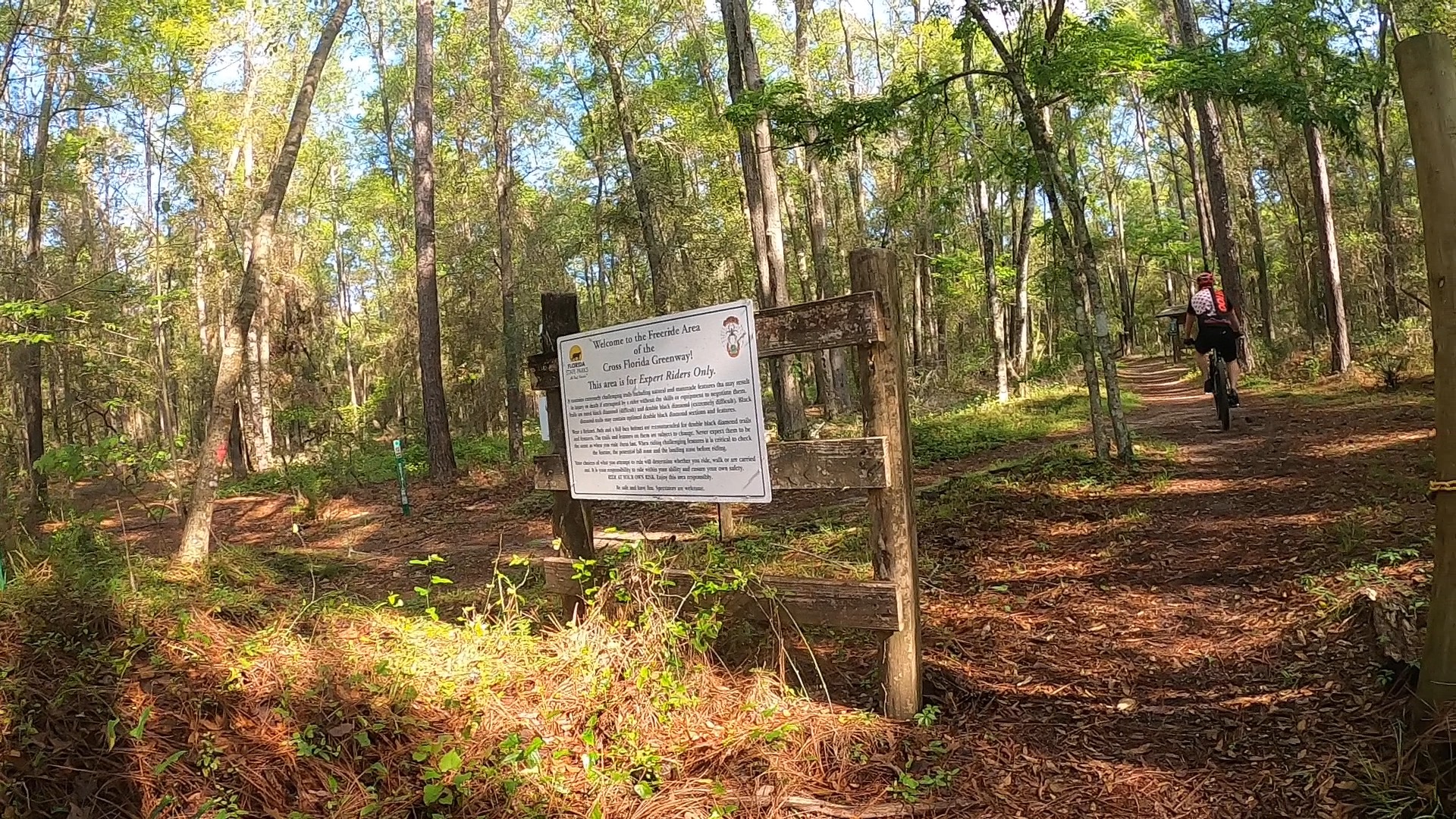
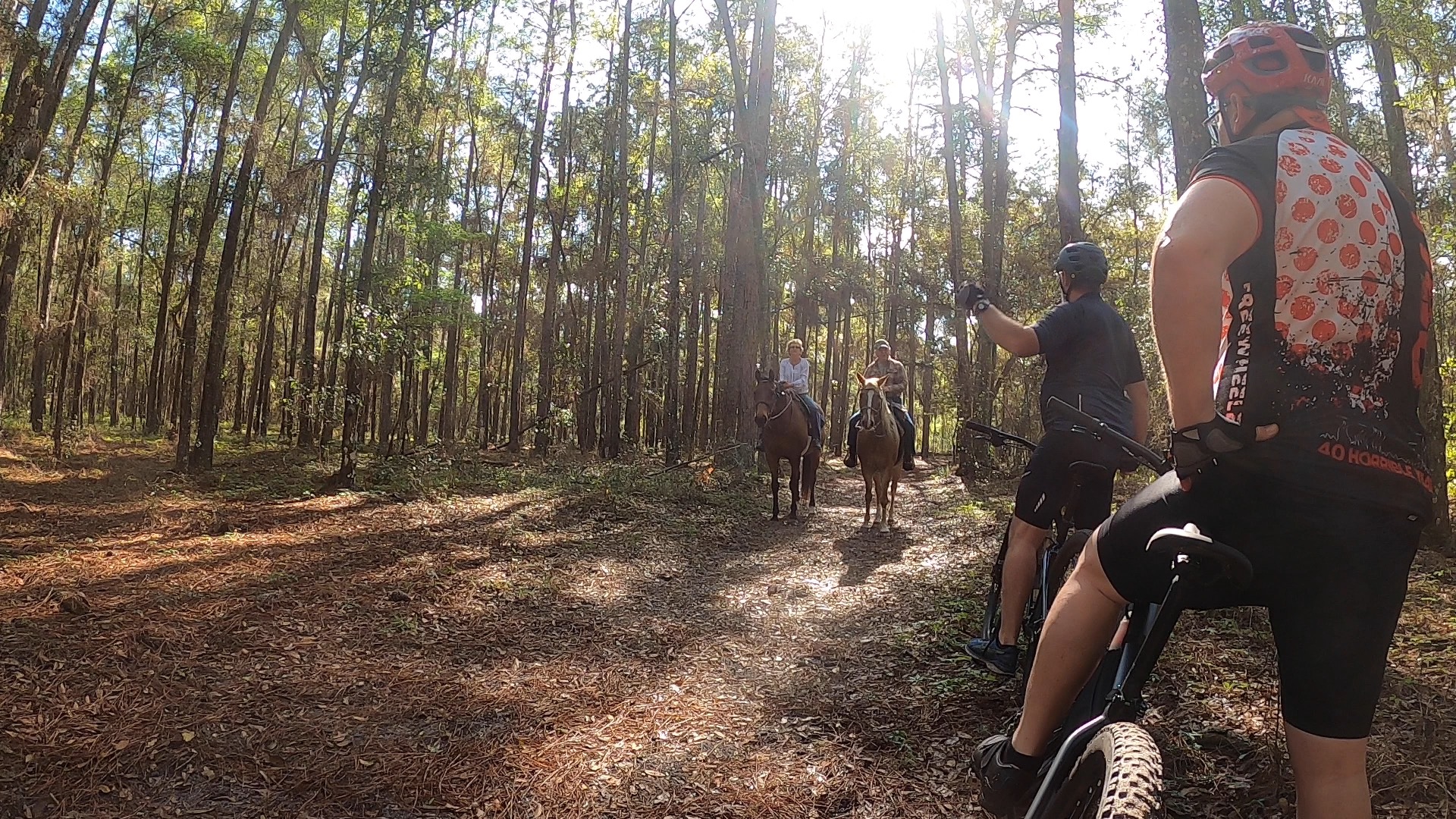
Sunday was a slightly different adventure, one I could’ve, almost nearly, put a damper on because this time, I over-mapped. I was tasked with planning a day out to celebrate a friend’s birthday. I knew the outdoors were a must, and as he recently got a new mountain bike, I started planning a trek to one of the best mountain biking locations within a couple hour radius of our homes. I went online and looked up maps of the mountain bike park, a cross-state trail that connected and we could possibly take after the main park; I looked up locations where we could stop for food and drinks along the way home and how far these were from each other and the best order to do them in. I PRINTED out maps to look on the car ride up (since it would be a surprise until we left). I thought I was leaving options to digress as the day took us, but I got too caught up in trying to make sure we had enough options and it would be fun. That was my first possible mistake.

The mountain bike park was great, truly. New trails, which are something the friend and I are big on, and different terrain. One thing I should mention is that sometimes I get a little overwhelmed by a new location with lots to explore. I want to see it ALL. I want to go down EVERY trail. Clearly this isn’t possible, and usually I can eventually go with the flow and tell myself it’s okay, we can come back, it leaves something to explore for next time. That thought process was lost on me Sunday. I had pulled up my mountain bike trail app on my phone and was constantly checking to see where we were and if we were going the “right” way. I’m pretty sure I was getting on everyone’s nerves, including my own, so I took tail and let some distance get between us so I couldn’t keep stopping the progress.

Eventually we made it back to our starting point where we would regroup with friend’s wife who graciously offered to just hang out and read while we explored and also pick us up at another trailhead after part two of our adventuring. Here is where my pre-planning basically fell apart, which probably would’ve been a good thing had I not pulled my trusty phone out again and found a detailed report of how to get from our point A to our point B. It wasn’t the paved trail I had anticipated, but a mix of woods and road, and sometimes challenging-to-find connection points. Each time we had to evaluate which way to go next, I started reading, and the friend just biked on figuring we’d eventually find our way. The mixture got us to our destination and we did have maybe a better adventure than part one because we really didn’t know where we were or how long it would take, but I’m not sure I enjoyed it as much as I could’ve had I just let go of the onus of navigation. 

I learned a few things in the end, at least I hope. Like the saying goes, the joy really should be in the journey. While navigation and GPS can be very helpful and practical tools, they aren’t always strictly necessary in the moment. They can hinder exploration, and fun. We weren’t likely to get hopelessly lost and if we missed a potentially cool trail, it would still be there the next time. You can’t possibly check out all the options in one session. Also, while I love course designing and making maps, it can also trigger my perfectionism and that can make the enjoyment factor go down very quickly, for myself, and for those around me. My new motto: Don’t Over-Map It!

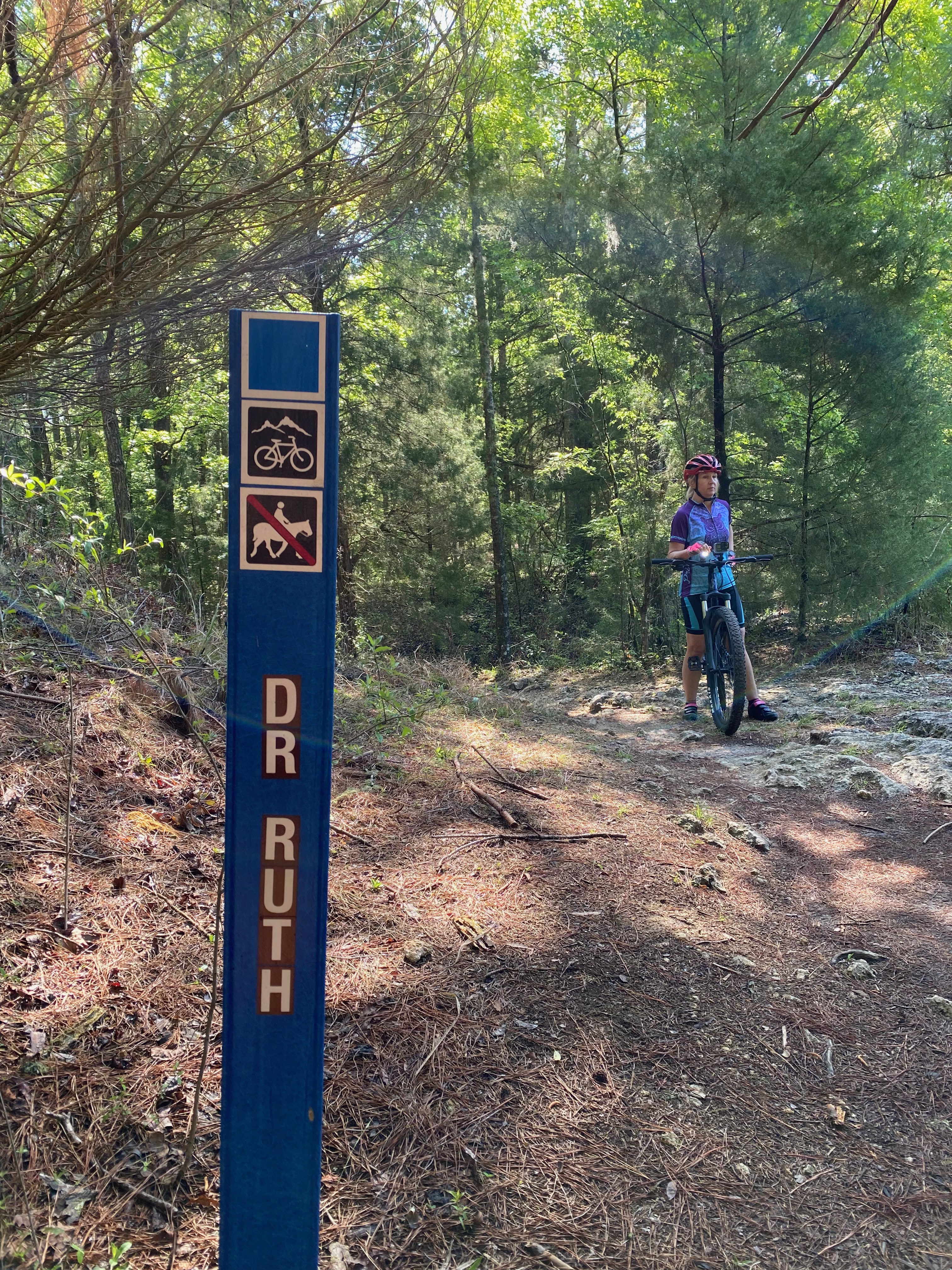
Santos Mountain Bike Park: Pine Tree, Dog Bone, Dog Tail, Dr Ruth at 4x speed

The Trembles

Change. Not my favorite topic. Last week I was pondering wide open spaces; looking out at horizons that seemed endless with little navigational guides along the way. As I was discussing that thought process with someone, they said, “You’re in the ‘trembles.'”

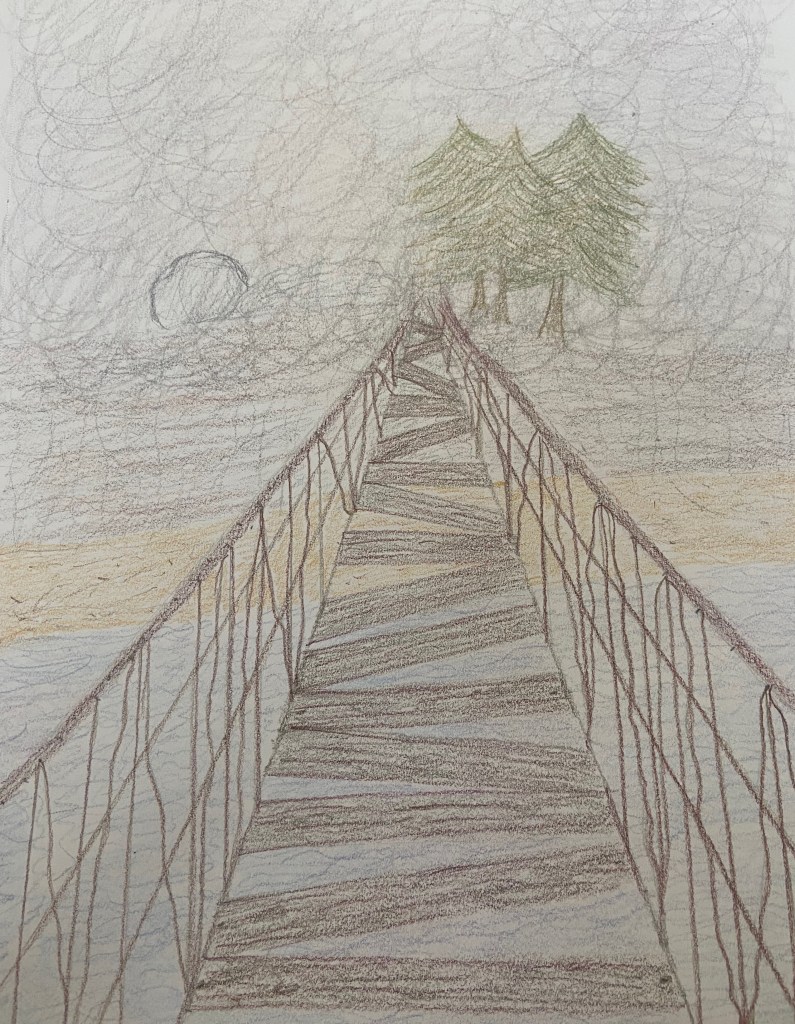
The” trembles” are what happens when you are trying to move forward in pursuit of new horizons, but you’re having to trust others’ roles in that process. Imagine a rope bridge over some kind of chasm or gorge. You have a general idea of where it’s going, but you didn’t build the bridge, and you’re not sure of it’s stability. There’s fog in the distance blurring what’s actually at the end of the bridge. (Think of that scene in Jurassic Park III, you know the one, where the precarious bridge starts rocking because there’s a freaking pterodactyl coming at the character…that kind of fog.) You have a guide, but they are ahead of you and you can’t see them very clearly; and it turns out they are only crossing for the first time too. They’ve got enough of the boards past their own weight and they trust it’s going to hold, but really, how do they know for sure? What if they make that final leap and one of those ropes isn’t secure enough to support a second traveler?

In my scenario there’s a swiftly flowing river below, and the fall is theoretically survivable, but I’m going to be swept downstream and I don’t know where that will end up either. I’d rather successfully pass the bridge even if each board forward wobbles a bit, even if the guide is at times purposefully making it sway just to test my stamina. If they make it and the bridge does fail, do I know if I’d try to hold on and climb my way up, or would I let go and let the current take me?

Perhaps in life we’re safer never stepping on those bridges; never experiencing the trembles. But sometimes what lies behind, staying in the status quo is scarier than possibly falling, or encountering a pterodactyl.

Wide Open Spaces

Grief is a weird and fickle beast, and like the proverbial elephant in the room, it can only be ignored for so long. In a span of less than four years I lost my mom, I moved across town after twenty-one years in the same house, I lost my dad, I had two major surgeries with organ removals, I quit my day job of fifteen plus years, my son graduated college and moved out on his own, and I ended an eight year stint of coaching. Oh, and yes, in the middle of it all there was a pandemic to navigate along with the rest of the world.

I’ve think I’ve avoided truly grieving each loss along the way. At times because I was afraid, at times because it felt self-indulgent, at times because I didn’t feel like I had the space to do so while managing other responsibilities, at times because I didn’t think the people around me could handle it, or would think less of me for not being strong enough to suck it up, and ultimately because wide open spaces aren’t easily navigated.

  • Fear – My life verse is 2 Timothy 1:7, “For God has not given us a spirit of fear, but of power, and of love, and of sound mind (or self control).” I am afraid of grief largely because I fear losing control or my soundness of mind. What if I go down that path and I don’t know how to come back? What if the path doesn’t have an end? Wide open space to a horizon that doesn’t seem to reach a boundary. 
  • Self-Indulgence – Grief feels very me-centered. With regard to losing my parents I think this has been unavoidable: I don’t have siblings, my grandparents are all dead, and my remaining aunts and uncles are distant. Who would share my feelings and memories and wonderings? Even when we find others who have had similar experiences, no two stories or relationships are truly the same, so grief is bound to be unique and lonely. A wide open space that is being navigated solo with no set path trampled by others who’ve gone before.

Every breaking wave on the shore

Tells the next one there’ll be one more

“Every breaking wave” u2
  • Responsibilities – This one is a two-edged sword. Often our responsibilities get in the way of our grief, and often they are our life preserver helping us keep our heads above the open seas. In the direct after of each of my losses I dove into my responsibilities: my job, my coaching, my looking after others, packing and unpacking our homes, etc. Sometimes I knew I was consciously avoiding grief, and sometimes these tasks were what kept me moving forward so that depression didn’t take hold. But as one of my favorite songs states, “Every breaking wave on the shore, tells the next one there’ll be one more…” No matter what I used to fill my head, heart, and time, those waves were going to continue to break. As the song goes on to say, I needed to let them sweep me off of my feet and learn to navigate that tide, rocks and all. 
  • Others – This one may be the hardest open space for me personally. This may be because in losing my parents I have also had to come to terms with some misconceptions I had about their relationship with each other, and their relationships with me. I’ve been left with questions that may never have answers. My ability to trust my own judgment has been hampered. I do worry what others think. I assume their patience with my processing has limits and I don’t know where those limits are…another wide open space that I’m fearful of navigating, or even beginning to traverse. I put a toe in that water, maybe even wade out knee deep, but my feet stay planted, ready to turn as soon as the floor feels the least bit unstable.

It’s possibly a tad ironic to use an analogy of unnavigable spaces today. We have every imaginable device literally at our fingertips to help us find our way. GPS is native to our cars, our computers, and our mobile phones, which may as well be an extension of our own bodies. We are too used to being able to find our way. While I enjoy the discipline of reading a map or following a trail marking system, I still pull out “the Google” if I question my way in the woods while out on a run, hike, or bike ride. I can read signs on the road, but it’s just easier to have Siri tell me where to turn, letting me know in advance which lane to be in. And speaking of Google, or the internet, we also have at our disposal a compendium of information and answers to more of life’s questions than we may ever need.

Unfortunately, grief doesn’t operate within the bounds of modern technology. We have to experience, navigate, and answer it “unplugged.” Each of us has to tackle the wide open space  like a pioneer with little to go on but just the constantly changing lay of the land. Certainly it’s conquerable if we are willing to dive in and let it surround us; if we are willing to lose our footing  along the way and learn to swim.

Are we ready to be swept off our feet

And stop chasing every breaking wave

The sea knows where are the rocks

And drowning is no sin

“Every breaking wave” u2

A Little Trail Reconnaissance

Mountain biking the “blue trail” at the Black Hammock Wilderness Area in Oviedo, FL. Video at 2x Speed.

This is a location that I have run previously but decided to tackle on the mountain bike today solely for the purpose of capturing the main trail on video to look at as a possible cross country practice course. Not my favorite place to bike, but somewhat easier way to grab the footage for further examination.